ACTIVE
AND PASSIVE SENTENCES
- A sentence is written in active voice when the subject of the sentence performs the action in the sentence.
- A sentence is written in passive voice when the subject of the sentence has an action done to it by someone or something else.
Example
active and passive :
1. I will clean the house every Saturday.
(active)
The house will be cleaned by me every
Saturday. (passive)
2. The staff is required to watch a
safety video every year. (active)
A safety video will be watched by the staff every year. (passive)
A safety video will be watched by the staff every year. (passive)
3. She faxed her application for a new
job. (active)
The application for a new job was faxed by her. (passive)
The application for a new job was faxed by her. (passive)
4. Tom painted the entire house. (active)
The entire house was painted by Tom. (passive)
The entire house was painted by Tom. (passive)
5. The teacher always answers the
students’ questions. (active)
The students’ questions are always answered by the teacher. (passive)
The students’ questions are always answered by the teacher. (passive)
RELATIVE CLAUSE
Relative
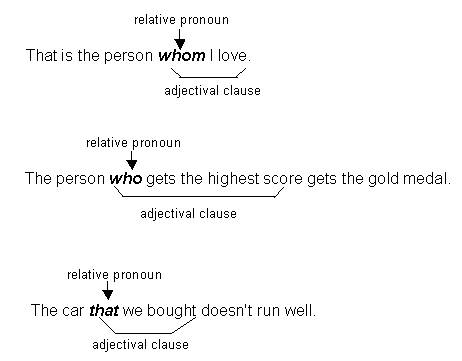
clauses are clauses starting with the relative pronouns who*, that, which,
whose, where, when. They are most often used to define or identify the noun
that precedes them.
DEFINING CLAUSES
A defining
or identifying clause tells us which specific person or thing we are
talking about in a larger group of people or things. If a defining relative
clause is removed, the meaning of the sentence changes significantly. A
defining relative clause is not separated from the rest of the sentence by
commas or parentheses.
EXAMPLES
·
- The woman who visited me in the hospital was very kind.
- The umbrella that I bought last week is already broken.
- The man who stole my backpack has been arrested.
- The weather that we had this summer was beautiful.
NON-DEFINING CLAUSES
A non-defining
or non-essential clause gives us more information about the person or
thing we are talking about. If a non-defining relative clause is removed from a
sentence, we lose some detail, but the overall meaning of the sentence remains
the same. Non-defining relative clauses are always set off from the rest of the
sentence with commas or parentheses.
EXAMPLES
·
- The farmer, whose name was Fred, sold us 10 pounds of potatoes.
- Elephants, which are the largest land mammals, live in herds of 10 or more adults.
- The author, who graduated from the same university I did, gave a wonderful presentation.
- My mother, who is 86, lives in Paris.
How to Form Relative
Clauses
Imagine,
a girl is talking to Tom. You want to know who she is and ask a friend whether
he knows her. You could say :
A
girl is talking to Tom. Do you know the girl?
That
sounds rather complicated, doesn't it? It would be easier with a relative
clause: you put both pieces of information into one sentence. Start with the
most important thing – you want to know who the girl is.
Do
you know the girl …
As
your friend cannot know which girl you are talking about, you need to put in
the additional information – the girl is talking to Tom. Use „the girl“
only in the first part of the sentence, in the second part replace it with the
relative pronoun (for people, use the relative pronoun „who“). So the final
sentence is :
Do
you know the girl who is talking to Tom ?
Relative Pronouns
|
Relative Pronoun
|
Use
|
Example
|
|
Who
|
subject or
object pronoun for people
|
I told you
about the woman who lives next door.
|
|
Which
|
subject or
object pronoun for animals and things
|
Do you see
the cat which is lying on the roof?
|
|
Which
|
referring
to a whole sentence
|
He couldn’t
read which surprised me.
|
|
Whose
|
possession
for people animals and things
|
Do you know
the boy whose mother is a nurse?
|
|
Whom
|
object
pronoun for people, especially in non-defining relative clauses (in defining
relative clauses we colloquially prefer who)
|
I was
invited by the professor whom I met at the conference.
|
|
That
|
subject or
object pronoun for people, animals and things in defining relative clauses
(who or which are also possible)
|
I don’t
like the table that stands in the kitchen.
|
CONDITIONAL
SENTENCES
A conditional
sentence is a sentence containing the word if. There are three common
types* of conditional sentence:
1.
If
clause > present simple tense : main clause > future tense (will)
·
If
you help me, I will help you.
·
If
I win the lottery, I will buy a new car.
·
If
it snows tomorrow, we will go skiing.
2.
If
clause > past simple tense : main clause > would
·
If
you knew her, you would agree with me.
·
If
I won the lottery, I would buy a new car.
·
If
it snowed tomorrow, we would go skiing.
3.
If
clause > past perfect tense : main clause > would have
·
If
you had helped me, I would have helped you.
·
If
I had won the lottery, I would have bought a new car.
·
If
it had snowed yesterday, we would have gone skiing.
Of course, it
is possible to start conditional sentences with the main clause:
·
I
will buy a new car if I win the lottery.
·
I
would buy a new car if I won the lottery.
·
I
would have bought a new car if I had won the lottery.
English
speakers choose one of the three conditional structures as follows :
A.
Conditional
one - to express a simple statement of fact or intent :
·
I
will buy a new car if I win the lottery.
·
I
will go home if you don't stop criticizing me.
·
You
will fail your exams if you don't start working harder.
·
She
will lose all her friends if she continues to talk about them behind their
backs.
B.
Conditional
two - to refer to a present unreal situation or to a situation in the
future that the speaker thinks is unlikely to happen :
·
If
I had a lot of money, I would buy a new car. (but I don't have a lot of money)
·
If
I were you, I would tell him you're sorry. (but I am not you)
·
If
I won the lottery, I would buy a new house. (but I don't expect to win the
lottery)
·
If
it snowed tomorrow, we would go skiing. (but I don't have much hope that it
will snow)
C.
Conditional
three - to refer to the past and situations that did not happen
·
If
it had snowed yesterday, we would have gone skiing. (but it didn't snow, so we
didn't go skiing)
·
If
you had studied harder, you would have passed your test. (but you didn't study
hard, so you didn't pass your test)
·
If
I had known that, I would have told you. (but I didn't know, so I didn't tell
you)
·
If
she hadn't been driving slowly, she would have had an accident. (but she was
driving slowly, so she didn't have an accident)
REFERENSI :